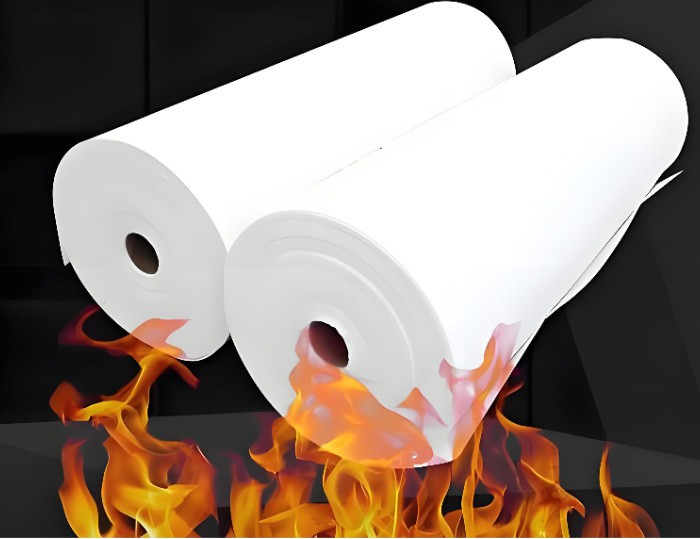
When paper (or cardboard) burns, the paper surface immediately ahead of the flame undergoes pyrolysis to generate gases; due to gas diffusion, the flame spreads beyond the pyrolysis zone, while simultaneous heat conduction within the material heats adjacent paper surfaces to their pyrolysis temperature. Flame retardancy refers to a material's ability to burn very slowly when exposed to an ignition source, and to cease burning and self-extinguish rapidly once the ignition source is removed.
To impart flame-retardant properties to paper (or cardboard), a three-pronged approach is required: isolating the paper surface from the flame to prevent combustion and flame spread across the surface; reducing or depleting the oxygen supply in the combustion environment to smother the flame; and lowering the temperature within the combustion zone-or utilizing fire-resistant fibers-to inhibit the pyrolysis of the paper surface.
These objectives are typically achieved through the addition of chemical agents known as flame retardants. Flame retardants achieve their purpose through various mechanisms, including endothermic effects, isolation effects, dilution effects, and inhibition effects. Under combustion conditions, phosphorus-based flame retardants generate volatile phosphorus compounds and phosphoric acid; these substances act in gaseous form to dilute the concentrations of oxygen and combustible gases, while the phosphoric acid transforms into metaphosphoric acid and poly-metaphosphoric acid, forming a non-volatile polymeric protective film over the burning solid phase. Halogen-based flame retardants undergo thermal decomposition during combustion to produce hydrogen halides; these compounds scavenge free radicals generated by polymer degradation, thereby delaying or interrupting the combustion chain reaction. Additionally, as non-flammable gases, hydrogen halides can form a high-concentration barrier on the surface of paper and paper products, effectively isolating them from the air. The flame-retardant action of borates stems primarily from their ability to form a glassy, inorganic intumescent coating; this coating promotes char formation, hinders the escape of volatile combustible substances, and undergoes dehydration at high temperatures-thereby providing endothermic cooling, foaming, and combustible-dilution effects. Upon thermal decomposition during combustion, nitrogen-based compounds release gases such as N₂, CO, and NH₃, thereby interrupting the supply of oxygen. Inorganic flame retardants-such as aluminum hydroxide (aluminum trihydrate)-release water vapor upon thermal decomposition; this vapor dilutes combustible gases while simultaneously providing a cooling effect, and also facilitates the formation of a carbonized layer that coats the surface of the paper product. Upon heating, magnesium hydroxide undergoes thermal decomposition, releasing crystal water and absorbing heat; the stable magnesium oxide produced by this decomposition forms a protective layer over the surface of combustible materials, thereby providing thermal insulation, while the generated water vapor reduces the concentration of combustible substances within the gas-phase combustion zone.